Hi guest! As you can see, the new Wizard Forums has been revived, and we are glad to have you visiting our site! However, it would be really helpful, both to you and us, if you registered on our website! Registering allows you to see all posts, and make posts yourself, which would be great if you could share your knowledge and opinions with us! You could also make posts to ask questions!
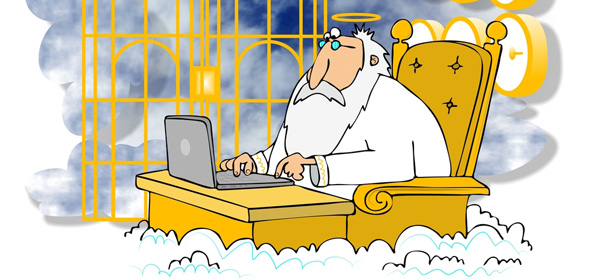
Saint Peter is shown as holding the keys to the gates of eternity and deciding who is allowed entry.
The Biblical Passage is: Matthew 16:18–19. Jesus says to Peter: “I will give you the keys of the kingdom of heaven; whatever you bind on earth will be bound in heaven, and whatever you loose on earth will be loosed in heaven.”
I wonder what would really matter if we were in front of those gates.
Would Saint Peter ask as to our faith in God?
Did we try to live a good life, repent, love others, forgive, or assist others?
Would our goals be less important than our mistakes? And is anyone really deserving of paradise?
What do you think Saint Peter would check for before opening the gates, if you had to be totally honest?
'Yeshua said,
If your leaders tell you, "Look, the kingdom is in heaven,"
then the birds of heaven will precede you.
If they say to you, "It's in the sea,"
then the fish will precede you.
But the kingdom is inside you and it is outside you.
When you know yourselves, then you will be known,
and you will understand that you are children of the living father.
But if you do not know yourselves,
then you dwell in poverty and you are poverty.'
-Gospel of Thomas, saying 3
I don't see heaven as an exclusive club we earn through good behavior. It's an immanent reality accessible through self-knowledge and virtue. We make heaven on earth through our seeking the divine and right action.
To enter heaven? At least once in your lifetime, you should read the Ramayana. If you are too lazy for that, with your dying breath, call the name of Lord Rama. If you are too weak for that, someone should whisper the name of Lord Rama to your ear as you are dying.
I will have to go with Belinda Carlisle on this question: “we’ll make heaven a place on earth”. Because - if I have eternal life, and I am currently alive, it seems to me that my eternal life has already begun, I just haven’t got to the part that happens after my physical body dies. This seems to jive with what that one dude said, something like, “the kingdom of God is within you”. So as far as how to get to Heaven, I’m just trying not to mess the present.
'Yeshua said,
If your leaders tell you, "Look, the kingdom is in heaven,"
then the birds of heaven will precede you.
If they say to you, "It's in the sea,"
then the fish will precede you.
But the kingdom is inside you and it is outside you.
When you know yourselves, then you will be known,
and you will understand that you are children of the living father.
But if you do not know yourselves,
then you dwell in poverty and you are poverty.'
-Gospel of Thomas, saying 3
I don't see heaven as an exclusive club we earn through good behavior. It's an immanent reality accessible through self-knowledge and virtue. We make heaven on earth through our seeking the divine and right action.
I think there’s maybe a middle ground between the two views. If I ever found myself standing in front of those gates, I suppose Saint Peter might ask whether I had been “worthy” of getting in.
But maybe what would really matter is the person I had become. Did I love people? Could I forgive? /Did I help when I had the chance? When I messed up, could I admit it, learn from it, and try to do better??
You mentioned that the kingdom exists both inside and outside of us, and I truly like that.
Maybe paradise is something we gradually come to understand while we are here, rather than just a place we go after we die.
So probably the question isn't, “Were you worthy?” but - “What did you do with the love you were given?”
That would be a pretty difficult question for any of us to answer.
'Yeshua said,
If your leaders tell you, "Look, the kingdom is in heaven,"
then the birds of heaven will precede you.
If they say to you, "It's in the sea,"
then the fish will precede you.
But the kingdom is inside you and it is outside you.
When you know yourselves, then you will be known,
and you will understand that you are children of the living father.
But if you do not know yourselves,
then you dwell in poverty and you are poverty.'
-Gospel of Thomas, saying 3
I don't see heaven as an exclusive club we earn through good behavior. It's an immanent reality accessible through self-knowledge and virtue. We make heaven on earth through our seeking the divine and right action.
Maybe Peter would be a little like a system administrator(sysAdmin) - checking the credentials and deciding who gets access.
Though this isn't a corporate server, and we're more than a username on a screen..
Whatever Peter would be looking for, I imagine he'd be looking at the person behind the account..
In today's modern world even heaven is upgraded . St Peter sits at the gate with a lap top computer . He will look you up ...
'' Aha ! Eldros .... as everyone does in this modern age , go with the angel into the download room and the angel will help you make a short youtube summarizing your life and email it to me for review ... then I shall decide if you are allowed in or not .''
So you go with the angel into the editing suit and you have access to a film about your life .... the angel asks you to edit it and make a 5 minute summary . When that is done the angel takes over and emails the result .
Why does the angel take over ? Because he does not send the summary , he sends all the bits you decided to edit out .
In today's modern world even heaven is upgraded . St Peter sits at the gate with a lap top computer . He will look you up ...
'' Aha ! Eldros .... as everyone does in this modern age , go with the angel into the download room and the angel will help you make a short youtube summarizing your life and email it to me for review ... then I shall decide if you are allowed in or not .''
So you go with the angel into the editing suit and you have access to a film about your life .... the angel asks you to edit it and make a 5 minute summary . When that is done the angel takes over and emails the result .
Why does the angel take over ? Because he does not send the summary , he sends all the bits you decided to edit out .
So, Peter is the perfect system administrator...
But the best part, I think, is the removed footage. /
The angel sends Peter everything we deleted after we pick the five minutes that make us look nice.
So maybe it’s not about making ourselves look good in the movie, but whether we’re ready for someone to see the whole picture - the good, the bad, and all the weird bits in between.
I suspect Peter would already know most of it anyway.
If I ever found myself standing in front of those gates, I suppose Saint Peter might ask whether I had been “worthy” of getting in.
But maybe what would really matter is the person I had become. Did I love people? Could I forgive? /Did I help when I had the chance? When I messed up, could I admit it, learn from it, and try to do better??
You can be a “normal” person with sins and still reach Heaven. After a fully conscious OBE, don’t remain here, ask your guide or raise your vibration and go there. It is a domain of profound peace and light, so harmonious that you may be tempted to remain there indefinitely.
You can be a “normal” person with sins and still reach Heaven. After a fully conscious OBE, don’t remain here, ask your guide or raise your vibration and go there. It is a domain of profound peace and light, so harmonious that you may be tempted to remain there indefinitely.
That is very interesting. I like the idea that even a normal person, with all of their flaws, might yet find their way to light and peace...
I was asking the question in the first place because I still don't know what happens to us after we die. I guess I was curious about what may actually be relevant if we ever found ourselves in front of those gates.
What you mean by "increasing your frequency" and getting there following an OBE also puzzles me. /Is it hard to put into words, or does it really feel like you’re entering another realm?
We may never know for sure what’s beyond those gates, but I find the whole idea exciting..
I was asking the question in the first place because I still don't know what happens to us after we die. I guess I was curious about what may actually be relevant if we ever found ourselves in front of those gates.
What you mean by "increasing your frequency" and getting there following an OBE also puzzles me. /Is it hard to put into words, or does it really feel like you’re entering another realm?
A fully conscious OBE is really similar to a NDE (Near‑Death Experience), and during it you can reach the same places people report after death, such as Heaven or Hell.
First of all, I believe that the Gospels teach a different Christ than the letters of Paul. The writings of the New Testament were not a unified narrative, though later editors and redactors such as Polycarp attempted to do so with what they had available. Additionally, the canon of the books and letters was in dispute with different Christian sects adopting or rejecting books until the 4th Century CE. Much scholarly ink has been spilled (and continues to be) in an effort to determine authors and timelines.
With that being said, making assumptions based on 20th/21st Century CE understandings of Christianity, often mired in doctrines, widely varying interpretations, translational errors, apologetics, etc., not to mention popular modern memes, is a recipe for confusion. What exactly is "heaven" to you? How do you know about this particular concept in your imagination in the first place? Why do you think "Saint Peter" is guarding some physical "gate" into a place you call "heaven"? Because you were told so? By whom? Where did they get that information?
Based on the understanding of a sect I was raised in, the "keys to the kingdom" were given to Peter so that salvation would become accessible to groups in a certain order: 1st to the Jews, 2nd to the Samaritans, and 3rd to the Gentiles.
Jesus told the criminal being executed next to him, the one that did not revile him, "Truly I tell you, today you will be with me in paradise." In another Gospel verse where he teaches of mercy, Jesus said, "To the extent that you did it to one of the least of these, my brothers, you did it to me. Jesus focused on forgiveness, but some Christian sects have since made "sin" and "hell" the stick with which to beat the flock.
Goetic magician. Saturn aspected. Death and Hell is my jam.
First, omg, This is the crux of it all, eh? And a very fraught topic, so best to ground in history ideas rather than internet.
In my view, drawing on the ancient Stoics, Catholicism, and ancient Orphism, as well as my own mystical experiences:
To enter “Heaven” which is a weird and probably the most fraught of all fraught words, aside from "taxes" or "magic" - it helps to see that for thousands of years it was seen as both a state of consciousness AND the “upper” part of the afterlife.The deep historical traditions all say the same thing, and the answer given here is often simpler than the elaborate ritual systems of most the ancient mystery cults would suggest.
Basically all you need to do is live a good life and learn to be calm. No secret rituals needed , no secret-decoder ring initiations, no esoteric knowledge is required. The Stoic apatheia, the Catholic Beatific Vision, and the Orphic purification of the emotions all describe the same basic metjods to make the soul fit for a state of peace and light by the cultivation of virtue and the mastery of turbulent passions/emotions such as anger, wrath, guilt, covetousness/grasping, and scheming/scrupulosity. Basically, all what we can call the “toxic ego” in a Buddhist way.
(The deep similarity of the teachings of Buddhism and Christianity is another topic and which entire books have been written, and I can't do just here. See The Noble Eightfold Path of Christ - Jesus teaches the Dharma of Buddhism by Thomas Ragland. 2003)
Okay, the Stoics.
The Stoics held that the soul at death is either "sent forth into a better life, destined to dwell with deity amid greater radiance and calm, or else, at least, without suffering any harm to itself, it will be mingled with nature again". They believed in reincarnation before it was trendy. This "greater radiance and calm" is the key here. The Stoic afterlife is a state of being that mirrors the soul's moral and emotional condition in life. Sound familiar, becasue it should. The Stoic goal of apatheia - as freedom from destructive passions - was not just an ethical ideal but a preparation for the soul's post-mortem state.
As the Catholic Encyclopedia notes, the Stoics "preached their apatheia" as the means by which one becomes "master of your self and fate". No special rituals were required becasue virtue itself was sufficient.
Orphism adds another dimension here with the purification of the soul from the "Titanic" elements of emotional turbulence and bodily attachment. The Orphic doctrine held that the soul must be purified by "passing through the elements which moved in sublunary space—air, water and fire." This was seen as a post-mortem ordeal reminiscent of Merkabah mysticism (that St. Paul was maybe a practitioner of, but this is debated.
Both Orphic and Merkabah traditions describe the soul's ascent through hostile or graded post-mortem realms after death - or in visionary experience - much like (or, cough, EXECTLY like) the Golden Dawn grades btw, hint, hint - with aboth emphasize purification as the prerequisite for reaching the highest state. In Orphism, the soul passes through the sublunary elements. in Merkabah, the mystic ascends through the hekhalot (palaces) guarded by angelic powers. The difference is that Orphic purification was primarily post-mortem (though ritual initiations anticipated it), while Merkabah ascent was a this-worldly visionary practice - though it was believed to mirror and prepare for the soul's postmortem journey. (hint hint)
Belgian historian of religion Franz Cumont (1868–1947), in his book "After Life in Roman Paganism" (Yale University Press, 1922). Has a discussion of Orphic and Pythagorean eschatology, where he contrasts the Orphic hope of escaping reincarnation through ritual purification with the broader pagan philosophical view that virtue alone could achieve the same end.
"No, the ancient Orphics already flattered themselves that by their cathartic rites they obtained for the soul an escape from the fatal cycle of generation and regaining of heaven for ever. The Pythagoreans inherited this doctrine, which they kept until the Roman period. In spite of the contrary opinion of certain thinkers, pagan philosophers and priests generally taught that after pilgrimages, more or less long, after a succession of deaths and rebirths, the purified spirits returned to dwell for ever in their celestial country. It was to this goal that the mysteries promised to lead their initiate; this was the end which the sages flattered themselves that they attained by their virtue."
Basically what he notes that the mysteries promised this goal to initiates by their rites - but that the sages claimed to attain the same objective by virtue. Here we can see the an early rift between "religion / philosophy" on one end and religon/theosis /theurgy / mysticism on the other. History contains both the ritualist claims and the virtue-based counter-claims.
FYI Sorcery is not concerned with the afterlife - only getting laid, paid and getting even. And sorcerers think you mystics are all air-fariy hippies.
Anyway, Catholic mystical theology dove-tails with this Stoic insight very cleanly. The Catechism describes Heaven as the "Beatific Vision," which is "characterized by a deep experience and unmediated knowledge of God, resulting in complete and utter happiness". Crucially, this is not primarily a physical location but "a state of being". The mystics consistently describe the soul's union with God in terms of consciousness and interior state. St. Teresa of Avila's "seventh dwelling place" is described as "the stage of full and perfect union with God through man's intellect and will contemplating God's essence and finding both the ultimate peace and joy therein". This is a state of consciousness that can, in principle, be anticipated in mystical contemplation during life. The "calm" the Stoics sought is the same "ultimate peace" the Catholic mystic finds in God.
I should add there here is a doctrine I utterly reject , which is that of the anti-cosmic "Second Death" post-mortem idea.
The ancient Egyptians had a horrible concept they called mw.t n wḥm - which literally meant "death of repetition" or "second death." This was not a physical death - that which was the first death and the gateway to the afterlife. The Second Death was the complete obliteration of your existence that followed the severe judgment of the dead. If the deceased's heart was weighed against the feather of Ma'at and found it is heavy (notes of Orphism again. I try to pay close attention when the same themes keep coming up again and again.) , the monster Ammit the Devourer - a cosmic monster that looked like a a hybrid of crocodile, lion, and hippopotamus, would consume the heart. Without a heart the disincarnated person could not exist in the afterlife. The Coffin Texts and the Book of the Dead contain spells explicitly meant to prevent this fate. The deceased recites formulas to ensure he will not "die a second time" in the underworld.
The Second Death appears again later in a particular strand of apocalyptic Judaism and some Christian thinking. I want to make it absolutely clear that Catholicism rejects these ideas as anti-human and anti-cosmic, as do I.
In the Aramaic Targums, the "second death" is the fate of the wicked in Gehinnom - a place of punishment and purification. In Revelation, the "second death" is equated with the lake of fire, the final destination of death, Hades, and all whose names are not in the Book of Life. This is not annihilation. It is a state of eternal ruin, whether understood as conscious torment or as a definitive separation from God.
The Catholic Church rejects total annihilation-ism as incompatible with the nature of the immortal soul and with the gravity of sin. As Catholic apologist Karlo Broussard explains, "For someone to definitively reject themselves from God but yet be annihilated, it would in some way seem to undermine the gravity of the sin." The soul is created for eternity and its choices have eternal weight. Annihilation would make the soul's final choice meaningless.
And more fundamentally, the Church rejects the anti-cosmic dualism that underlies the "second death" imagery. The idea that there is a "lake of fire" outside of God's good creation, a realm of pure destruction into which the damned are thrown. That idea is a purely Manichaean contruct - and hinges on the idea that there are two ultimate principles, one good and one evil, one of light and one of darkness, and that the evil principle has its own domain of ruin. The Catholic faith rejects this absolutely. There is one God, the Creator of all things visible and invisible. Everything that exists is good, because it is created by God. Evil is not a substance; it is a privation of good, a perversion of the will. Hell is not a place God created for the wicked; it is the state of a soul that has cut itself off from the source of all life and goodness.
Sorry for the preaching, but it only sounds that way because people only think of Catholicism as a religion (which it is too) rather than what it is first - a mystical practice concerned only with making sure you have a better post-mortem experience. The goal is to become a certain kind of being, one capable of experiencing the Beatific Vision, which is not a place but a state of consciousness, a state of union with God.
Anyway, what the Stoics called it apatheia. The Orphics called purification. The Catholic mystics call it the Unitive Way. It is all the same method in different cutlire and mythic languages - but we might also see them the shared methods and techniques to strip away the "toxic ego," of our turbulent passions, the grasping, the guilt, the wrath, the scheming, the scrupulosity - so that the soul becomes light, calm, and fit for eternity in the better places of the afterlife. (What this mean is a whole other topic) .
I hate it so a horrible, anti-human, anticosmic heresy it makes my eyes wobble. Sorry to go on about this! This is why the "second death" doctrine is so alien to the mystical POINT of all this, in my opinion. A God who annihilates souls or tortures them forever is not the God of the mystics. The God of Teresa of Avila, of John of the Cross, of Catherine of Siena, is a God of love who respects the soul's freedom so profoundly that He allows it to choose separation - but that separation is a state of the soul, not an act of divine violence. Again, sorry for what sounds like preaching.
Post automatically merged:
Hmm. I tired to add this to the above:
Basically all you need to do is live a good life and learn to be calm. (And the living of the "good life" in the mystical traditions is only to help make you calm and centered. We can think of it as "avoiding all drama and hysteria" but raised to the level of a mystical practice.)
Post automatically merged:
Oh, one note for modern times. Sorry to go on abut this.
As a Folk Catholic dual-faith mystic (Catholic and Thelemite) and magician - but also hetero, and also a pro-LGBTQ lefty - there are points I feel need addressing here. My houngan was gay. The Haitian lwa were always coming to him and saying he needed to get married and have kids. He was like, “Nope, that's not gonna happen.” But to them, as ancient long-view beings, that was just what the “good life” meant to them - but one that, I think, if we insist too much, only creates drama, suffering, and hysteria that might cause the soul to become upset and disquieted. The mystics tell us that the soul must be calm, purified, freed from turbulent passions. But what does forcing a gay man into a straight marriage produce here? Drama. Suffering. Hysteria. The turbulence all the mystics warn against. It produces a soul at war with itself.
So I just wanted to say, while I talk about Catholic mystical traditions, that I also disagree with some of the more conservative interpretations of the Church’s teachings. To those who are reticent to enage with the better Catholcisms, yeah I get it. (And to more right-wing people: I also don’t want turbo-lib rainbow virtue-signalling plastered over all signage and media. Some is fine.)
I think what happened is the Church has not changed from the more pro-natalist agrarian times. Your community and peoples really did need more people to survive when there was no healthcare system, and kids to take care of the elderly. The total East-West Church as an alost 2 thousand year of insitution move much more slowly beacsue they still have to speak to over 1.4 billion Catholics on a PLANETARY scale, often in very conservative cultures who would rebel at full interjection of Western liberalism.
Post automatically merged:
Oh, one note for modern times. Sorry to go on abut this.
As a Folk Catholic dual-faith mystic (Catholic and Thelemite) and magician - but also hetero, and also a pro-LGBTQ lefty - there are points I feel need addressing here. My houngan was gay. The Haitian lwa were always coming to him and saying he needed to get married and have kids. He was like, “Nope, that's not gonna happen.” But to them, as ancient long-view beings, that was just what the “good life” meant to them - but one that, I think, if we insist too much, only creates drama, suffering, and hysteria that might cause the soul to become upset and disquieted. The mystics tell us that the soul must be calm, purified, freed from turbulent passions. But what does forcing a gay man into a straight marriage produce here? Drama. Suffering. Hysteria. The turbulence all the mystics warn against. It produces a soul at war with itself.
So I just wanted to say, while I talk about Catholic mystical traditions, that I also disagree with some of the more conservative interpretations of the Church’s teachings. To those who are reticent to enage with the better Catholcisms, yeah I get it. (And to more right-wing people: I also don’t want turbo-lib rainbow virtue-signalling plastered over all signage and media. Some is fine.)
I think what happened is the Church has not changed from the more pro-natalist agrarian times. Your community and peoples really did need more people to survive when there was no healthcare system, and kids to take care of the elderly. The total East-West Church as an alost 2 thousand year of insitution move much more slowly beacsue they still have to speak to over 1.4 billion Catholics on a PLANETARY scale, often in very conservative cultures who would rebel at full interjection of Western liberalism.
If to 'enter heaven' means to be remembered by entities in an immanent, hylozoic, hyperdimensional bulk for reincarnation, then that's a result of an intended or natural chiral asymmetric alignment with the universe leading to the recognized positive sum of the associated local temporal pattern becoming retained nonlocally after death.
I can only tell you how I hope to face any afterlife guardian or judge: with simplicity, clarity, and sincerity.
I expect that the wisdom of that situation, embodied in the penetrating awareness and insight of the guardian, will cast my being in a somewhat unfamiliar light, revealing things about myself that I may not like (and perhaps some things that I do like). The best thing to do in that case is to accept with humility whatever is revealed, and thus be reconciled to the truth, instead of seeking to avoid the truth - which can only lead to greater hardening of the shells of egoic self-deception, and the alienation and fruitless wanderings.
In the meantime, I seek to prepare for this situation by regularly making time to allow as much of this ultimate perspective as possible to shine into my awareness and to show me what needs to be seen.
Catholicism: “You will not be absorbed into the One. You are already immortal and will remain yourself forever.”
LHP: “Wait - that’s it?”
Catholicism: “That’s it. Now go to Confession and be nice.”
LHP: “But I want to be my own god.”
Catholicism: “Sit down.”
If to 'enter heaven' means to be remembered by entities in an immanent, hylozoic, hyperdimensional bulk for reincarnation, then that's a result of an intended or natural chiral asymmetric alignment with the universe leading to the recognized positive sum of the associated local temporal pattern becoming retained nonlocally after death.
It's important to note that this natural selection applies to all biological life and any discrete pattern be it a sunset or raindrops as the universe evolves. And that being immanent it doesn't support or need any theistic or panentheistic considerations to model the operation or put it in motion.
The fear of death disappears after your first conscious OBE (Out-Of-Body), because you directly experience your own immortality.
A fully conscious OBE is really similar to a NDE (Near‑Death Experience), and during it you can reach the same places people report after death, such as Heaven or Hell.
Interesting. I can understand why something like that would change the way you see death.
But, I still have no idea what happens to us after we die.
I’m open to the possibility that consciousness is more than we can understand, but I wonder how you can tell whether an OBE is truly taking you outside of your brain.
I’d really like to know what it actually feels like, because that’s the part I find very interesting.
First of all, I believe that the Gospels teach a different Christ than the letters of Paul. The writings of the New Testament were not a unified narrative, though later editors and redactors such as Polycarp attempted to do so with what they had available. Additionally, the canon of the books and letters was in dispute with different Christian sects adopting or rejecting books until the 4th Century CE. Much scholarly ink has been spilled (and continues to be) in an effort to determine authors and timelines.
With that being said, making assumptions based on 20th/21st Century CE understandings of Christianity, often mired in doctrines, widely varying interpretations, translational errors, apologetics, etc., not to mention popular modern memes, is a recipe for confusion. What exactly is "heaven" to you? How do you know about this particular concept in your imagination in the first place? Why do you think "Saint Peter" is guarding some physical "gate" into a place you call "heaven"? Because you were told so? By whom? Where did they get that information?
Based on the understanding of a sect I was raised in, the "keys to the kingdom" were given to Peter so that salvation would become accessible to groups in a certain order: 1st to the Jews, 2nd to the Samaritans, and 3rd to the Gentiles.
Jesus told the criminal being executed next to him, the one that did not revile him, "Truly I tell you, today you will be with me in paradise." In another Gospel verse where he teaches of mercy, Jesus said, "To the extent that you did it to one of the least of these, my brothers, you did it to me. Jesus focused on forgiveness, but some Christian sects have since made "sin" and "hell" the stick with which to beat the flock.
I believe that's what I was trying to say with the gates image. I have no idea if there is a heaven or where our souls go after deathh. There may or may not be...
So I wasn't really seeing Saint Peter as a real gatekeeper, but rather as a way of asking the question, "What would really matter if there is something after this life?"
Maybe not whether we lived perfectly or had all the correct beliefs, but rather whether we loved, forgave, and made an effort to put things right when we made mistakes.
And if this is the life we truly know we have, I think those questions are still important even if there is no afterlife at all.
Catholicism: “You will not be absorbed into the One. You are already immortal and will remain yourself forever.”
LHP: “Wait - that’s it?”
Catholicism: “That’s it. Now go to Confession and be nice.”
LHP: “But I want to be my own god.”
Catholicism: “Sit down.”
We have no idea what's behind those gates.
But I doubt Peter would be checking to see if we were perfect if we imagined there was. Maybe more along the lines of: Did you love anyone? Did you cause harm to others and then become aware of it? Have you made an effort to put things right?
None of us is likely to come and say, "Yes, I really deserve to be here."
And the “I want to be my own god” part...
St Peter: “Yeah, yeah. We’ll talk about that later. First, let's discuss your behavior down there.”