Hi guest! As you can see, the new Wizard Forums has been revived, and we are glad to have you visiting our site! However, it would be really helpful, both to you and us, if you registered on our website! Registering allows you to see all posts, and make posts yourself, which would be great if you could share your knowledge and opinions with us! You could also make posts to ask questions!
We humans like to see ourselves as above the rest of animals, or at least as different. There is something different about us, which seems to be the case. What makes us different and what was it that made us first time different from other animals?
It seems to be accepted that humans became humans when they started burring the dead. The argument says that ti meant that we showed recognition for other people and respect for the dead. (apologies if I'm wrong, writing from my cheese like memory) Also it sometimes notes fear from death.
After thinking about it a little I have to disagree. Death was companion to humans far before they ever became humans, we were evolved predators of Africa, we saw death too often to not be used to it. And honestly, other animals are proven to mourn their dead, so that doesn't work really either. Burring of the dead was in my opinion practical. Unlike other primates we couldn't just stop going to place where someone died, it became more practical to burry the dead. Dead bodies were danger of infection, that never changed. Fear of death is religious shit, that came to make people follow certain religions. Before that people knew where they were going after death. They might have fear of the dead, maybe partly based on sickness that could be gained from being close to the rotting body, but that was not fear of stop existing or something like that, it was just way forward.
In my opinion, what made us different was ambition. We somewhere, somehow started to want more. We started to seek to become better and/or different from what we were and what we were capable of. Both physically and spiritually. That led us towards development towards who we are today. That gave us reason to seek development in things no animal would ever seek or even need. Animals are also creative, just like us they can think, imagine, create, think outside the box, but they never seek to become greater than they are. They do not seek self mastery. They do not really seek the new ways to do things without need for it. We do.
Just a quibble but in our African, early hominid phase we were more scavengers than predators. The rise of hunting as a major food source doesn't take place until our first migrations out of Africa.
The three major features that seem to set early homo sapiens apart from other animals are: opposable thumbs, control of fire, and language. The 'ambition' thing you are talking about develops only much later, corresponding more-or-less to agricultural modes of life, or at least to what are called 'delayed return' societies.
We humans like to see ourselves as above the rest of animals, or at least as different. There is something different about us, which seems to be the case. What makes us different and what was it that made us first time different from other animals?
Well well well .... so magic can meet Antropology (in others aside from me - I started studying it sooooo far back, University was for free here ! )
You have hit upon one iof the ( and one of mine ) prime base subjects and something I spent a near lifetime ( because I ain't dead yet ) looking into .... AND ... observing the academic shifting views about this over time .
Many papers, many discussions and many dissents - I have even had people argue with me that there is no essential difference ! My answer to that was ; look around !
It seems to be accepted that humans became humans when they started burring the dead. The argument says that ti meant that we showed recognition for other people and respect for the dead. (apologies if I'm wrong, writing from my cheese like memory) Also it sometimes notes fear from death.
Recognizing death was an old one . At University in the early 70s they were pushing the significant difference as 'Man the toolmaker ' . We since discovered other species can do that to an extent , so that got thrown out .... to an extent , but its at the base of it ... 'technology maker' might be more accurate , what does that mean ? I'll get to that in a minute .
After thinking about it a little I have to disagree. Death was companion to humans far before they ever became humans, we were evolved predators of Africa, we saw death too often to not be used to it. And honestly, other animals are proven to mourn their dead, so that doesn't work really either. Burring of the dead was in my opinion practical. Unlike other primates we couldn't just stop going to place where someone died, it became more practical to burry the dead. Dead bodies were danger of infection, that never changed. Fear of death is religious shit, that came to make people follow certain religions. Before that people knew where they were going after death. They might have fear of the dead, maybe partly based on sickness that could be gained from being close to the rotting body, but that was not fear of stop existing or something like that, it was just way forward.
Yes, this is one of the things they recognize as significantly human , but, as you say , it isnt quite enough . What seems to count now is ritual burial .... and again that ties in with my ideas . The early first ones of these seem to accept the addition of ochre on the body , and of course 'grave goods' . Here is what it all has to do with (in my theory ) - the imagination ; finding ways and expressing them of 'solving problems and issues ' in a way that is is not immediately related to or apparent to the issue at hand . ( Ha ! Every time I write it out it comes out different ) .
In my opinion, what made us different was ambition. We somewhere, somehow started to want more. We started to seek to become better and/or different from what we were and what we were capable of. Both physically and spiritually. That led us towards development towards who we are today. That gave us reason to seek development in things no animal would ever seek or even need. Animals are also creative, just like us they can think, imagine, create, think outside the box, but they never seek to become greater than they are. They do not seek self mastery. They do not really seek the new ways to do things without need for it. We do.
We also have a whole set of things WE claim that make us different from the other animals , as we suppose they do not have those functions eg 'self awareness ' ??? how are we going to test that ? with a mirror ? Nah , modern people are used to mirrors , show one to a person that has never seen nor heard of one and they behave similar to other animals that react to a mirror . There are a whole range of 'differences' we can eliminate if we cant prove an animal cannot have those functions . ' Man the fire maker' was another . Your 'control fire' is much better ... fire 'making' , is probably one indicator , more so than fire 'use' , some birds 'use fire' the Aussie 'fire hawk' is one . But then again , they can 'control' fire , by spreading it , but not eliminating it , large grazing animals like rhinoceros will trample a small one .
An animal might make and fashion a simple tool for a purpose at hand but 'Man' makes tools ( and this extended into technology of today by the same internal process ) for a purpose not necessarily at hand , he imagines a future use . he thinks about what might or could happen in his imagination and then thinks of ways to remedy that and then , most importantly , makes it in material production . The obvious evidence is all around us . He will take such inventions with him although he may not need them at the time of making or in the immediate future . No animal does that . It relates to the imagination and the development of the human frontal cortex .
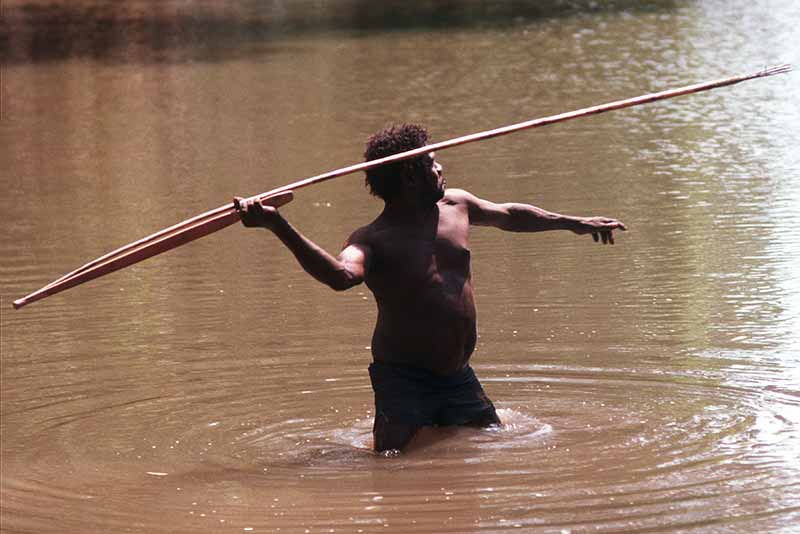
More significantly , I think, is the development of the 'multi-function' tool . One such is the woomera , generally known as a spear thrower .
Most are familiar with this use , using the leverage to increase power and distance , But look at the top image ; depending on the style of manufacture it can also be used as a club , a digging tool , a bowl for collecting small game , fruits and seeds , a water ladle , a stone blade can be fitted into the handle base to make a 'tula' a kind of adze , you can turn it sideways and use like a saw on a soft piece of wood to get an ember for fire making , a shield , the hook / notch at the end ( to fit the spear in ) can also be used as a high hooking too, to pull down vines or fruits , a palette for crushing ochres and similar to use for painting and various other adaptions / designs in various areas to suit the local environmental uses .
This shows the full development of the human imagination about WHAT MIGHT BE needed and a tool, technology or process to try and remedy or compliment it . Animals certainly might do that ... I mean, for all I know they might think that ... but they dont DO anything about it .
Some dispute this and point to 'technology' like the termite nest and their complex societies ( also termites were the forst farmers ... seriously ;
( so ... if any one tells you the difference between animals and humans is 'farming ' ... )
So, to recap, I think it is that ability to imagine visualize and make tools and artifacts and systems for a future use, particularly a multi use in one tool , that was not presently apparent .
One further devloping dynamic that came to light was change of environment and the new challenges that presented ; at times of great difficulty or disruption , recovery seems boosted at some following stage * . new lands and challenges helped develop this human facility
* Eg Mt Toba super volcano and the expansion from 'Eden in the East '
Just a quibble but in our African, early hominid phase we were more scavengers than predators. The rise of hunting as a major food source doesn't take place until our first migrations out of Africa.
Evidence from archaeological sites in East Africa (like the Olduvai Gorge) reveals early stone tools and animal bones bearing cut marks, proving these early hominins were butchering and actively hunting. That is Homo Erectus and Olduvai Gorge is in Africa .
The three major features that seem to set early homo sapiens apart from other animals are: opposable thumbs, control of fire, and language. The 'ambition' thing you are talking about develops only much later, corresponding more-or-less to agricultural modes of life, or at least to what are called 'delayed return' societies.
All primates have opposable thumbs ... koalas got two of them on each hand ! Possoms got em on back legs and even some frogs have them . Control of fire, we did above . Language ? Now that's an intersting one ... right at the forefront of nerw studies that one ( dont see why , have not they ever talked with a magpie ? ) ;
Evidence from archaeological sites in East Africa (like the Olduvai Gorge) reveals early stone tools and animal bones bearing cut marks, proving these early hominins were butchering and actively hunting. That is Homo Erectus and Olduvai Gorge is in Africa .
Africa is actually the place were humans evolved into highly organised apex predator hunters .
Where did you get this scavenger only idea until we left Africa ?
Evidence of butchering is not evidence of hunting. Indeed, our ability to butcher is part of the argumentation that supports the understanding of our role as scavengers. And to address your point more specifically, the Olduvai Gorge meat is specifically believed to have been scavenged (
And I didn't say "scavenger only." Making absolutist claims like that would be foolish. I said more scavenger than hunter. The oldest unambiguous evidence for consistent hunting appears 400,000 years ago in Germany (










 )
) 