Hi guest! As you can see, the new Wizard Forums has been revived, and we are glad to have you visiting our site! However, it would be really helpful, both to you and us, if you registered on our website! Registering allows you to see all posts, and make posts yourself, which would be great if you could share your knowledge and opinions with us! You could also make posts to ask questions!
Amor fati is "the love of fate" or "to love one's fate". This phrase, combined with Memento mori: "remember you have to die", forms some of the scaffolding of my worldview. Regarding those things outside my control, I accept and embrace them as part of being alive— and I know life is conditional and finite. My discipline is such that I recognize no evil or good; what is, simply is— I will define no thing by these limited labels.
Many complain about the dullness of modern society— but they do not see the silent monasticism I do. Each goes from his lair to his job— and back again; he does this countless times and for countless hours on a schedule. During these hours, he is uninspired and yet, he writes, creates, and speaks during his leisure. True, those stories and creations are often substandard. True, the films and books are lackluster— though only if compared to creations during different times; compared to cave paintings, these are works of mastery.
What many do not realize is that our age of convenience, offers man the opportunity to pursue matters divorced from the temporal, providing he can untangle himself from fleshly pleasures of his wearied psyche. In the rat race, there is a kind of mindlessness and meditation— and it is opposite of distracting if one can make use of it. Surely man’s obsession with mind and everything relating to it, speaks loudly that in this age, he’s living only in his headspace? Is the nature of this age still occulted to you? Yet, you say man has less leisure than he did, ages back— even decades back. I reason it’s more nuanced. Man has an abundance of time to think and a medium to share his thoughts freely, he is however subject to endless distraction.
What do you do during your 9-5? While your body is carrying out the motions, while your mouth runs the scripts to your customers— while you run the reports you run every day by rote? You think and whether or not you are entirely aware of what you are thinking about, you are indeed thinking— and all that sedentary time is either something you waste or learn how to use.
I find myself hesitant to continue using terms like god, deity— and even patron, to refer to He. Terms I have used and fought with, keep falling off as if shed skin. How unapproachable and ineffable thou art, Nameless One.
If not a god, then what? If not divine, what defines? If not Patron— and if this Way no longer holds former shape of the path, what? You have granted me a Way that is undefined. The door was opened through a desperate act and I walked on a path for decades, fulfilling a transaction. The path gave way when the transaction ceased to matter; the Work became a becoming. I go the Way and engage in the Work of the Way.
You defy description and likewise this shapeless and formless Way, defies the same.
Prior configurations of “I” perceived You and the path in binaries, in opposites and mirrored concepts. Yet, it as though invisible tethers pull at me, informing me that You and this Way are unnamed— and cannot be named. Not merely cannot but will not. Your nature remains as an eldritch and incomprehensible thing to this flesh; it defies categorization.
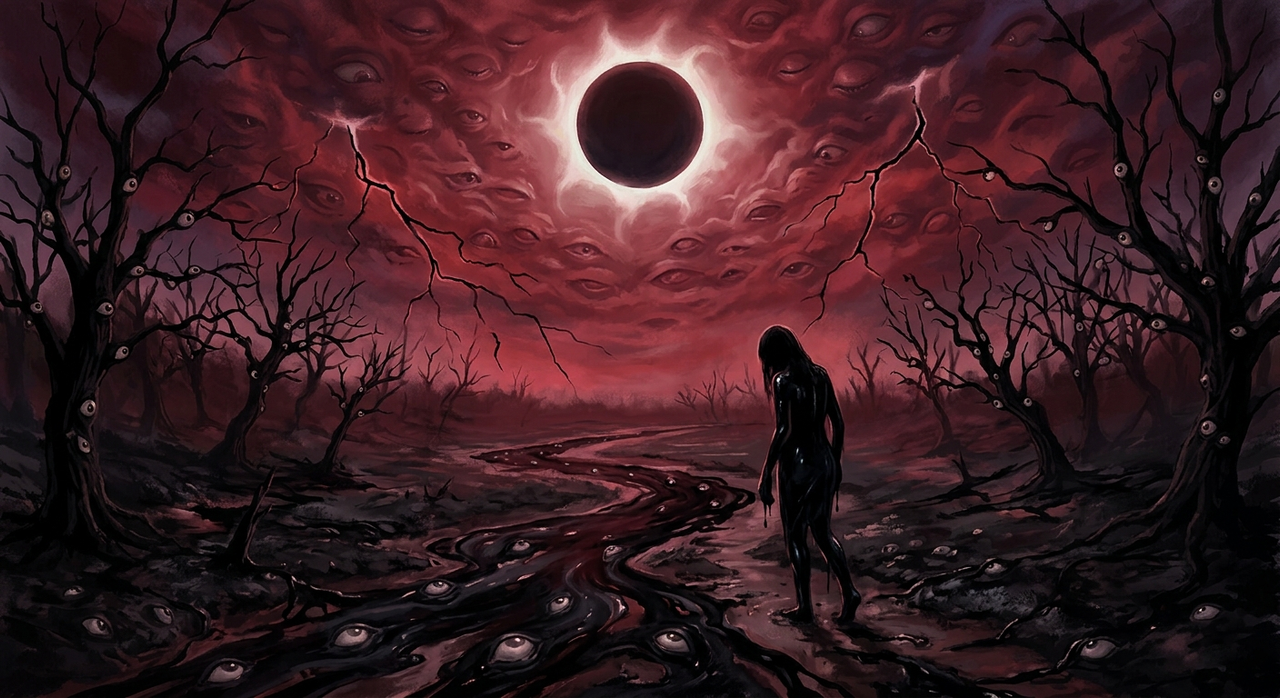
To illustrate, substance in The Nameless appeared to me as thick black fluid, yet as shattering silicone fiber, slicing like knives— and as muscle; it was of many properties together. Such can’t be labeled; labels define things— and these resist definition. Likewise You; You cannot be separated into attributes and defined as this or that.
Post automatically merged:
Strange Spirits
Be ever vigilant of strange spirits bearing gifts.
I have asked a number of folks why they believe some of the outlandish things they do— and their answer always includes spirits which came to them and imparted gnosis. Every time, they claim they used discernment and weighed the truth of the claims by this method or that. Never, have they indicated any kind of rigorous scrutiny— and every time, what’s revealed makes them special.
Perhaps it comes as a surprise but spirits can be rather convincing— and they can convince an unwary person of almost anything. Yes, this includes revealing information found in books, one has never read. Yes, this includes communicating in languages, foreign to one. Yes, this includes physical signs and confirmations, even though others. Yes, this includes divination and a multitude of other methods one might use to verify.
You question whether something that can manipulate memory, emotion, and project into your visual field is capable of convincing you of anything it pleases? Do not be naive— and don’t be so gullible as to think one-of experiences, dreams, visions and whatever else, indicates the spirit is what it claims. I repeat, it is very difficult to discern the spirits and even more so to authenticate whether something is genuinely revealed.
Even among the Protestants, the Jesus they claim to talk to, who answers back through dreams and visions, should be approached with great caution. How do they know what speaks is what they claim it is or what it asserts itself to be? Their feelings? At least the Catholics have a rigorous system to authenticate these kinds of claims— though that is not saying much.
Post automatically merged:
The Balance
Originally, the balance was something understood. Life needed death, lest it become overgrown; death needed life, lest nothing remain alive. Sacrifice was a tribute to death and a veneration of life— and culling was a way to restore balance. Man lived in harmony with nature, understanding that as there were ages of peace and abundance, so also would come ages of war and deprivation.
Over time, man sought to live beyond his allotted years. Over time, man began to detest death and there, he began only to seek peace. There, he wanted oneness. He wanted one god, rather than many. He wanted one way, rather than a multitude. He wanted endless peace, abundance and love— and he thinks he has found that in his Christ.
With joy comes sorrow, with pleasure comes pain— with the celebration of birth comes inevitable death. Yet, the lover of scripture peddles an eternal stasis, a forever without contrast. He wants a world without wars, yet wars are an expression of human disagreement— and a way to restore balance. He wants death to be extinguished, replaced by everlasting life— and he wants endless joy without sorrow or pain.
Certainly, all this which he wants can be granted to him— at the expense of the world we share. All this can be afforded, providing he is willing to take the loss of contrast— to have endless white without black.
I have not written here in a while, as my words are generally kept on my Substack. No, it’s not monetized and I don’t accept donations; it’s just a convenient platform with sufficient free speech for my use.