• Hi guest! As you can see, the new Wizard Forums has been revived, and we are glad to have you visiting our site! However, it would be really helpful, both to you and us, if you registered on our website! Registering allows you to see all posts, and make posts yourself, which would be great if you could share your knowledge and opinions with us! You could also make posts to ask questions!

Crawling Nightshade: Uses both Mundane and Magical?

Digiquo

Zealot
Joined
Nov 2, 2025
Messages
102
Reaction score
138
Awards
3
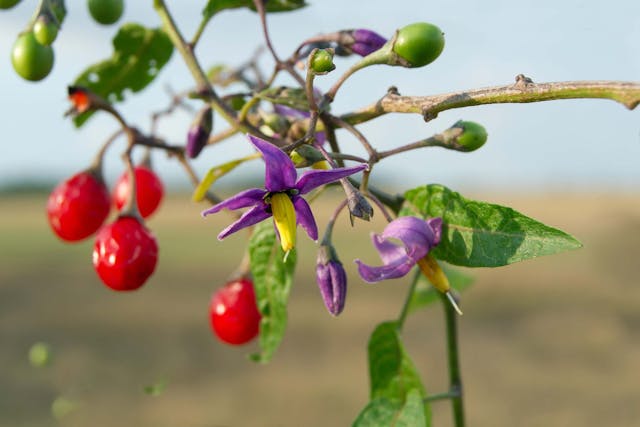
I have a large amount of crawling nightshade growing around my house, and after some research I learned much of the plant is actually edible and low to non-toxic when prepared properly and eaten when ripe. A cursory glance also showed me it was often planted to guard against witchcraft. Does anyone know of any specific recipes and/or usages for this plant? It is very prolific, and it's colors are quite lovely when it's in bloom throughout the summer and the berries begin to ripen to a bright red. I'd like to see about utilizing it as more than just a decorative plant.
climbing-nightshade-poisoning.jpg
 

Ignotus

Apprentice
Joined
Jul 9, 2026
Messages
50
Reaction score
160
Crawling Nightshade is still toxic when its ripe. Are you confusing it with black nightshade? Those berries are edible when ripe, i have a lot of it growing in my garden.
But i woldn´t try eating crawling nightshade unless you feel like poisoning yourself.
It even doesn´t have the deliriant effects that belladonna or henbane has. It basically just makes you sick, so I´d leave it alone or use it in ways that don´t involve eating it
 

Tryp

Apprentice
Joined
Jul 19, 2023
Messages
60
Reaction score
615
Awards
3
Beautiful berries, I haven't worked with this one and I know little about its virtues, but you made me curious and went to my library to check.

In regards to toxicity, reports differ slightly (a bit like the black nightshade, S. nigrum). I'm finding both references and folk names that suggest berries have been eaten and stems (sweet flavored, thanks to a reaction mediated by saliva) chewed in several parts of Europe. Black nightshade, like bittersweet, also has "don't eat it" reports and others, that I know by personal communication, that swear by the berries used to prepare a nice pie. So caution makes sense, but in this case toxicity appears to be generally low. Variations in reports for these kinds of berries may be due to bioregional, seasonal factors or ripeness. So if you plan to try any, in a preparation or otherwise, be careful at first to see how your population behaves. I'm saying this because they are certainly not devoid of tropane alkaloids; some therapeutic properties seem to agree with their presence, especially in berries. Perhaps safer to try with stems first.

Sources attribute it slightly narcotic properties, antispasmodic (useful against cough and intestinal discomfort caused by spasms) and for rheumatic pain. All of these are internal uses, a light decoction of steams and leaves, and are classical applications of herbs with tropanes. Another registered use in this sense is to treat dropsy. The infusion has application in some skin ailments and is reported to "help clear skin stains" in folk medicine of my area (Southern Europe), the Balkans and Poland (Dioscorides also wrote that topical use can cause "hair loss", so beware with that). Berries have been directly rubbed to soothe wasp stings.

Few reports of magical uses. Apotropaic, mostly. Schulke writes about its use by herders, "who hung it around the necks of animals to dispel the Evil Eye", and documents its use in protection charms, either braided in wreaths or its juice applied to amulets.
 

Ignotus

Apprentice
Joined
Jul 9, 2026
Messages
50
Reaction score
160
@Tryp You´re right about the berries, I remembered them as being more toxic than they actually are. Apparently the fully ripe ones are almost free of alkaloids
Dr. Christian Rätsch writes in his Encyclopedia of Psychoactive Plants:
Solanum dulcamara L. [syn. Dulcamara flexuosa Moench, Solanum laxum Royle, Solanum lyratum, Solanum scandes Lamk.] - Bittersweet Nightshade

This nightshade has been identified as the “sleep-inducing strychnos” described by Dioscorides (see Strychnos nux-vomica; Schneider 1974, III: 274*). In antiquity, the root bark was taken in wine as a sleeping aid.

The Germanic peoples already used the plant as a narcotic and referred to both it and Solanum nigrum as “Nachtschaden,” meaning “night harm.” This was the name of an illness believed to be caused by an elfin demon, or nightmare spirit, during sleep, and which could be treated with Solanum dulcamara. The illness “was to be counteracted by another magically powerful elfin demon embodied in the plant; in other words, the patient’s nighttime restlessness was to be soothed by a narcotic substance” (Höfler 1990: 96*).

Bittersweet nightshade “was regarded as an elfin herb and is still known as Alpranke, or ‘nightmare-spirit vine.’ It was placed in children’s cradles to protect them from enchantment and hung around the necks of livestock against ‘Hunsch,’ or shortness of breath. People generally seem to have an aversion to this plant, calling it sow’s vine, stinking devil, dog berry, choking root, and so on. It is also regarded as a symbol of a treacherous person” (Perger 1864: 182*).

During the Middle Ages, the berries were strung on a cord and worn around the neck as an amulet or talisman against slander. The plant also featured in other magical customs: “Dried stems bearing an enemy’s name were placed outside that person’s door to initiate a revenge spell, [and] the berries could be used as a magical aid in all transformation spells, especially those involving lycanthropy, or transformation into a wolf” (Magister Botanicus 1995: 193*). It may also have been an ingredient in witches’ ointments.

In Mexico, the plant is called dulcamara or jazmincillo and is used in folk medicine as a sedative and narcotic. Solanine derivatives and tropane alkaloids have been detected in Mexican plant material (Díaz 1979: 85*).

The above-ground herbaceous parts contain 0.3 to 3.0% steroidal alkaloid glycosides, while the roots contain approximately 1.4%. The alkaloid content of the fruit decreases as it ripens. Ripe fruits are almost entirely free of alkaloids (Teuscher 1994: 737). Both the alkaloid content and its composition can vary considerably (Máthé and Máthé 1979). There may be chemically distinct variants, or chemotypes, that are psychoactive.

Going by what Rätsch writes, the fully ripe berries might even be safer than the stems, with hardly any alkaloids left in them compared to the 0.3-3% in the herbaceous parts
 

Eldros

Zealot
Joined
Aug 10, 2026
Messages
108
Reaction score
129
Awards
2
Yes, that’s bittersweet/climbing nightshade (Solanum dulcamara).
It’s a really pretty plant, especially when those purple flowers turn into red berries. It does spread like crazy, though!
I’d be careful about eating it.
The ripe berries are toxic, but they’re less toxic than the unripe ones. It has a pretty interesting history in folk medicine, but personally, I’d admire it rather than cook with it.
 

Tryp

Apprentice
Joined
Jul 19, 2023
Messages
60
Reaction score
615
Awards
3
Going by what Rätsch writes, the fully ripe berries might even be safer than the stems, with hardly any alkaloids left in them compared to the 0.3-3% in the herbaceous parts
Thanks for checking with Rätsch. Worth noting that this 0.3-3% alkaloids in herbaceous parts corresponds principally to glycoalkaloids like solanine, which is a mild poison also found in potato and tomato leaves. Something we'd rather avoid, but less dangerous than tropane alkaloids by weight.
 
Top